

Minister M. Katelynas: The Baltic Sea Region Must Act Together in the Face of Hybrid Threats
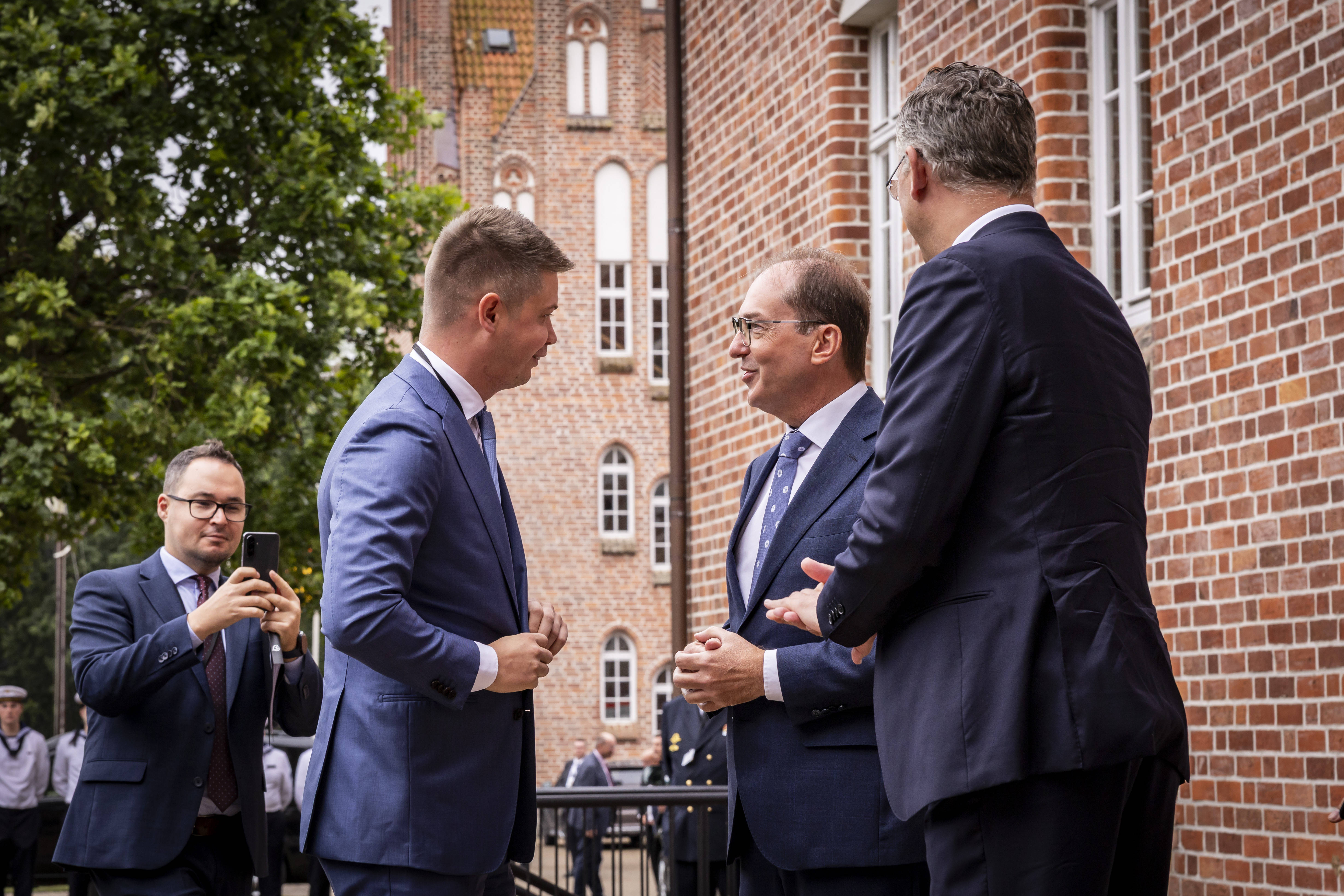
Minister of the Interior Martynas Katelynas participated in the Baltic Sea Security Summit in Flensburg, Germany, where, together with ministers from Germany, Sweden, Estonia, Norway, Latvia, the Netherlands, Ireland, Poland, Finland and Denmark, he discussed ways to strengthen regional security, enhance the protection of critical infrastructure and improve the joint response to hybrid threats.
The discussions focused on Russia’s hybrid activities, threats posed by unmanned aerial vehicles, disinformation, the protection of airspace and critical infrastructure, and the need to further strengthen cooperation among the countries of the Baltic Sea region.
“Hostile neighbouring states are constantly testing the resilience of our countries and looking for vulnerabilities. The greatest mistake would be to assess each incident in isolation. What may initially appear to be an isolated incident can form part of a coordinated hybrid campaign. Our response must therefore be comprehensive and coordinated,” Minister M. Katelynas said.
The Minister of the Interior noted that Lithuania is confronted with a wide range of hybrid threats, including the instrumentalisation of irregular migration, GPS interference, false bomb threats, information attacks, repeated violations of airspace and threats to critical infrastructure. Such activities may be interconnected and form part of broader hybrid campaigns.
According to Minister M. Katelynas, the so-called “crime-as-a-service” model is being used with increasing frequency, with criminal actors exploited to advance the interests of hostile states. Individual incidents should therefore not be treated merely as ordinary criminal activity. Possible links between them and their broader context must also be assessed.
Minister M. Katelynas stressed the need for the European Union to strengthen its common assessment of hybrid threats by making greater use of criminal intelligence and law-enforcement information provided by Member States.
He also called for stronger real-time information exchange on low-altitude airspace and incidents involving critical maritime infrastructure, as well as better connectivity between information-sharing mechanisms used by EU institutions and Member States’ law-enforcement, intelligence and border authorities.
“We cannot allow a situation in which different institutions deal with separate incidents without identifying possible links between them. Every law-enforcement authority must be part of a common information network. Only closer integration of intelligence, law-enforcement and border-management efforts can provide a comprehensive situational picture,” the Minister said.
Particular attention was also devoted to threats posed by unmanned aerial vehicles and other airborne objects. Lithuania is developing an integrated airspace surveillance and response model involving the Armed Forces, the State Border Guard Service and the Public Security Service. The aim is to ensure a shared situational picture and coordinated response.
Lithuania is also working with the defence industry to develop technological solutions for detecting and neutralising balloons that may be used to carry contraband or other payloads posing risks to civil aviation and critical infrastructure.
The meeting also addressed the growing challenge of disinformation. In Lithuania, law-enforcement authorities take action where disinformation amounts to criminal conduct, monitor the information environment, exchange relevant information and cooperate with online platforms on the removal of illegal content. According to the Minister, further measures are needed at EU level to enable the early detection of coordinated disinformation campaigns, including AI-generated bots, coordinated account networks and deepfakes.
“The stronger our cooperation before a crisis, the stronger our response will be when a crisis occurs. We must ensure that hostile actors cannot exploit our borders, differences in institutional responsibilities or gaps in information. The security of the Baltic Sea region depends on our ability to act together,” Minister M. Katelynas said.
As Lithuania prepares for its Presidency of the Council of the European Union, it intends to place particular emphasis on strengthening common European capabilities, improving the assessment of hybrid threats and information exchange, enhancing the protection of critical infrastructure, countering disinformation and strengthening societal resilience to emerging threats.